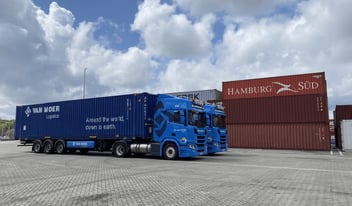
Van Moer Logistics operates the largest tank container terminal in the Hamburg–Le Havre range: an average of 1,250 container movements a day across three sites, and up to 1,350 trucks on a peak day. Those containers hold chemicals and flammable goods, so knowing exactly where each one is standing is not an efficiency question — it is a safety and compliance question. Cloudway built the cloud platform** that now holds that live picture.
When the yard and the system disagree
The needs of Van Moer Logistics
The European Seveso Directive requires a terminal operator to be able to demonstrate the exact location of every tank of hazardous substances, at any moment. That is straightforward to write down and hard to guarantee on a working yard.
In practice, at busy terminals somewhere between 10% and — exceptionally — 60% of containers are not in the position the records say they are. The reason is a chain reaction: one container set down in the wrong slot displaces the next, and the next, until operators are spending their shift hunting for boxes or manually correcting the record. The cost is not only the lost time. In an ADR environment, any uncertainty about what is standing where is a potential hazard.
Van Moer Logistics wanted the location of every tank container known continuously and accurately, and wanted that information fed into the systems the terminal already runs on.
Reading the yard as it happens
Rather than tagging containers, the consortium chose to see them. A stereo camera mounted on the stacker — the vehicle that lifts and moves containers — both captures the image and measures the distance to each object. A purpose-built AI model recognises containers in the frame and then reads the container ID with OCR, and a high-accuracy GPS antenna fixes the stacker's own position, so the container's position can be calculated relative to it.
Containers are stacked, which means several of them share a set of GPS coordinates. So an additional algorithm determines the stack level for each video frame: the result is not just latitude and longitude but the height position too.
The volume of data that generates is the interesting constraint. Streaming raw video off a battery-powered vehicle would be expensive in transmission cost and in stacker runtime, so the AI model runs locally, on an NVIDIA Jetson edge device, and only the processed results travel onward over 5G.
The platform behind it
That is where Cloudway's work sits: everything from the moment a result leaves the stacker.
We built the cloud platform on Microsoft Azure, designed around a continuous stream of position events arriving from moving vehicles over a mobile network. Devices publish over MQTT into Azure IoT Hub; Azure Stream Analytics processes the position events as they arrive rather than in batches; Azure Functions and Container Apps carry the processing and the integration work; and Azure Cosmos DB holds the resulting picture of the yard so it can be queried immediately and at scale. Application Insights provides the observability, which on a platform whose data source is a vehicle in a port is not a nicety — you need to know the difference between a container that has not moved and a device that has stopped reporting.
The requirement shaping all of it is that the yard picture has to stay current while events keep arriving, and stay queryable while it is being written to. And it had to integrate with the terminal's existing systems, because a live position that lives only in a new application does not change how the terminal runs.
Why 5G makes the difference
This has been attempted before with conventional connectivity. What changed is the network. A private 5G network supplies the bandwidth and the reliability for real-time communication, and — through Massive MIMO, beamforming and network slicing — stable, granular coverage across an entire industrial site. Combined with a private APN, the result is a fully isolated network reachable only by the customer's own devices.
Large industrial sites are exactly where traditional networks struggle: many simultaneous connections, a lot of metal, and signal pollution. Here 5G is the backbone that makes the rest viable.
Cloud native technologies used
- Cloud services: Microsoft Azure — IoT Hub, Stream Analytics, Functions, Container Apps, Cosmos DB, Application Insights
- Device protocol: MQTT
- Architecture: event-driven and stream-based, built for continuous ingest from moving assets
- Edge: AI inference on an NVIDIA Jetson, so only processed results are transmitted
- Connectivity: private 5G with a private APN
- Sensing: stereo camera for image and distance, high-accuracy GPS, AI object recognition with OCR and stack-level detection
The result: control, and time back
- Locations that hold up. Within three weeks the system was correctly locating 70% of all containers, at an overall detection rate of 96%.
- 33 minutes per shift, per operator. Time that used to go on searching and correcting. That translates directly into savings on labour, fuel and stacker rental.
- Safety as a by-product. A live, verified picture of the yard means a misplaced tank is visible as a misplacement rather than discovered as an incident — which is what the Seveso obligation is actually asking for.
- Headroom. The platform is built to support monitoring of up to 40,000 containers a day.
It generalises
The solution was designed for the hardest version of the problem — a hazardous-goods terminal — but nothing about it is specific to tank containers. Other container terminals, distribution centres and logistics hubs are the obvious next cases; indoor warehousing and retail floors are the less obvious ones. Wherever knowing where an object is has to come with real-time data and security attached, the same pattern applies.
What began as a proof of concept on a single stacker is now a scalable, reusable solution.
This was a consortium project. Van Moer Logistics led it, with the Cronos Group contributing Industry 4.0 expertise, Proximus the 5G network, and the University of Antwerp its research on innovative technology in the port. Within Xplore Group the delivery was shared: OnEdge integrated the hardware, InfoFarm developed and trained the AI model, Unlock'd built the multi-device front-end that gives operators and yard managers the live view — and Cloudway built the cloud platform described here.
Do you have assets moving around a site, and a system that only finds out where they went afterwards?
our experts are happy to look at it with you.